Tai Chi, Touch Amplifier
Touch and Embodied Technology after Eve Kosofsky Sedgwick

Even more immediately than other perceptual systems, it seems, the sense of touch makes nonsense out of any dualistic understanding of agency and passivity; to touch is always already to reach out, to fondle, to heft, to tap, or to enfold, and always also to understand other people or natural forces as having effectually done so before oneself, if only in the making of the textured object.
(Eve Kosofsky Sedgwick, Touching Feeling)
Touch Amplifiers
Much of the practice of taiji (tai chi) is organised by the exploration of internal experience, with the implicit or explicit aim of improving bodily control and wellbeing, for whatever reason. However, part of the promise of taiji is being able to control the movements of other people via an ostensibly relaxed deployment of touch and leverage. There are many people for whom this ‘martial’ dimension of taiji is not appealing. But some teachers (including my own, and including me, if and when I am a teacher) argue that learning the more martial aspects of taiji can feed directly back into one’s own health and wellbeing goals. More precisely, the practice of push-hands (tuishu, 推手) functions as a kind of ‘amplifier’ for awareness of our own bodily movements and sensations.
Taiji push-hands centres around the gentle contact of one’s palms with a partner’s wrist and elbow in a pushing and yielding sequence that involves the alternation of whose palms are against whose wrist and elbow, depending on where in the sequence one is. The forward ‘push’ movement involves the pusher’s palms on the partner’s wrist and elbow. The corresponding ‘yield’ of the person being pushed involves them sinking backward, away from – but maintaining contact with – the push.
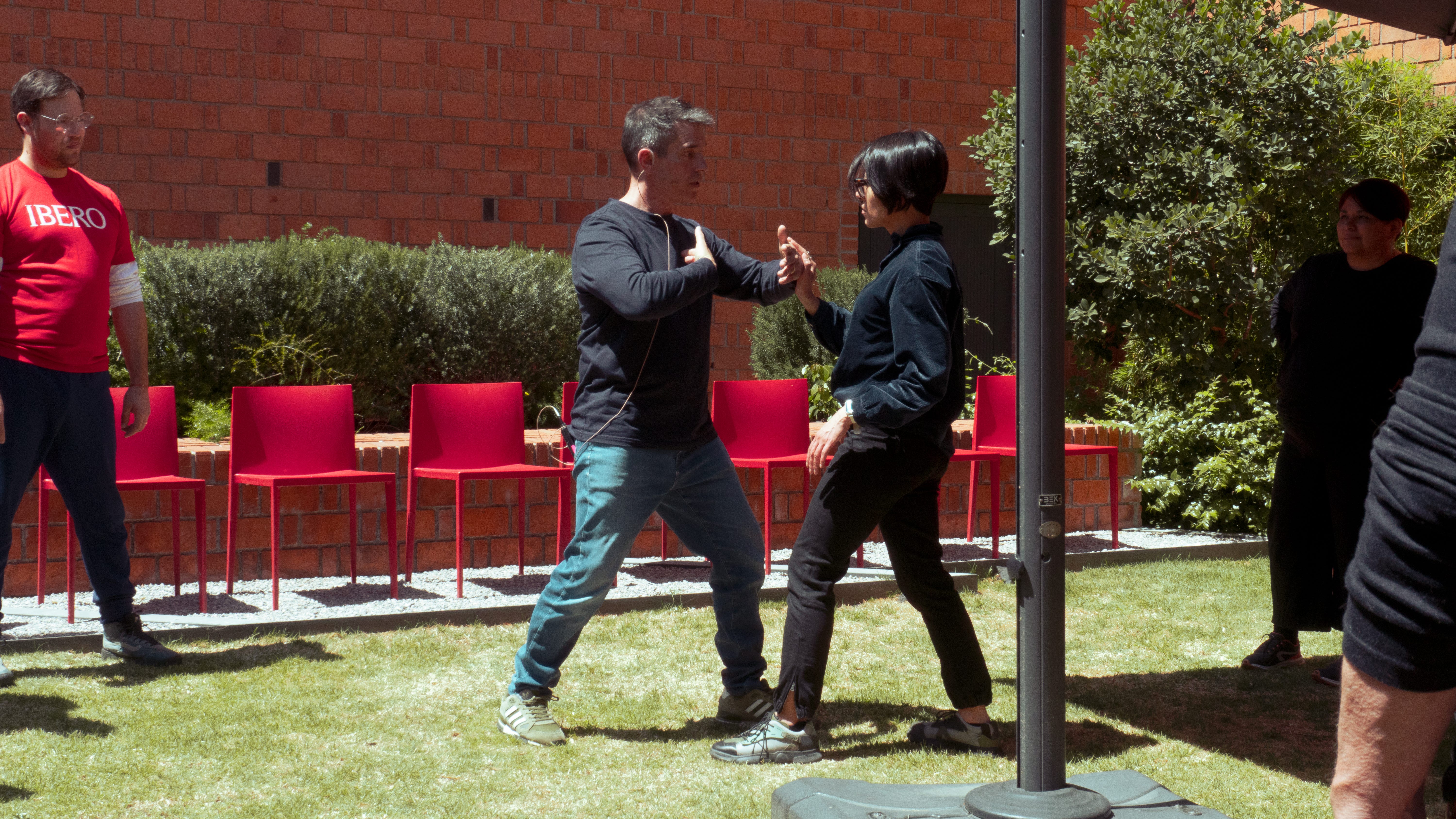
“Push towards my centreline”. Tai Chi and Embodied Philosophy workshop, Universidad Iberoamericana, Mexico, 26 March 2026. Photos courtesy of Kamila Téllez Islas: Instagram @kammtei
Maintaining gentle contact is called sticking. In order to be able to ‘stick’, one must first (and simultaneously) develop an awareness of touch that is referred to as ‘listening’ (ting / ting jin, 听劲). That is to say, one must feel whether the opponent’s hands are pushing forward, pulling backward, or exerting no particular force, and respond immediately, like the force’s shadow, so to speak. At the same time, the person issuing the force (i.e., pushing) must also be ‘listening’, so that they do not meet force with force, but work around or with any counterforce or resistance.
In essence, as a push progresses, the opponent’s yield becomes a turn; the push is deflected and converts into the opponent’s push. While this is largely a sensitivity drill – an exercise in ‘listening’ to the force of the other, yielding to that force, feeling it disperse as it is gently and naturally deflected by a turn, a turn which then turns into a push back – there are also several points within the sequence where it can become combative or martial. The push can become more forceful and deliberately seek to disrupt, uproot and displace the opponent. In response, the person being pushed might be able to yield to that force in such a way that it ‘misses’ them, and convert it into a disruptive force of their own – for example, by gently adding a pull to the end of the opponent’s push, uprooting them and making them fall forward.
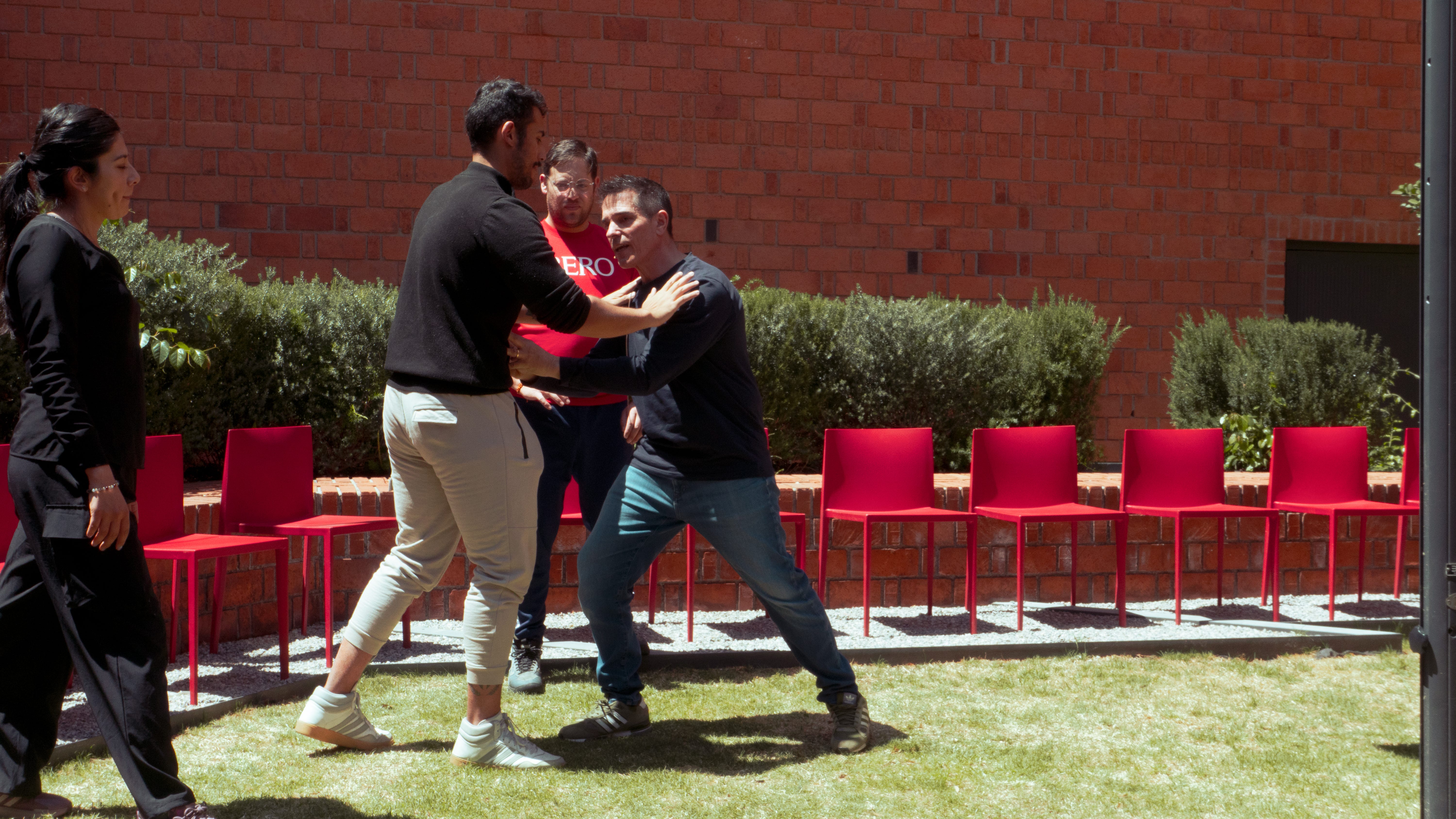
“Push”. Tai Chi and Embodied Philosophy workshop, Universidad Iberoamericana, Mexico, 26 March 2026. Photos courtesy of Kamila Téllez Islas: Instagram @kammtei
Central to push-hands is the development of the sense of touch so that it far exceeds the confines of the palms, or the point of contact of another’s palm on one’s skin. If psychoanalysis and phenomenology have each in their own ways connected our consciousness, mind or awareness with the places on our skin we can feel, then push-hands radically expands this. If you are training in push-hands, then someone’s push on your elbow and wrist while practicing first activates your sense of where your hand is in relation to your body. Later, you will be aware of whether your shoulder is tensed and raised or relaxed and low. Then, you will feel clearly where your weight is being held, and whether this is helpful (allowing movement) or hindering. You will feel whether your centreline is positioned correctly in relation to your partner. (The centreline is a theoretical vertical line, often referred to in martial arts training, that you could draw on an anatomy picture from navel to solar plexus, and – in ideal positioning – all the way up the centre of the chin, nose, and between the eyes, and all the way down to a position that is equidistant between the feet. Much taiji and other martial arts training involves commanding one’s own centreline and disorientating or disrupting the other’s.)
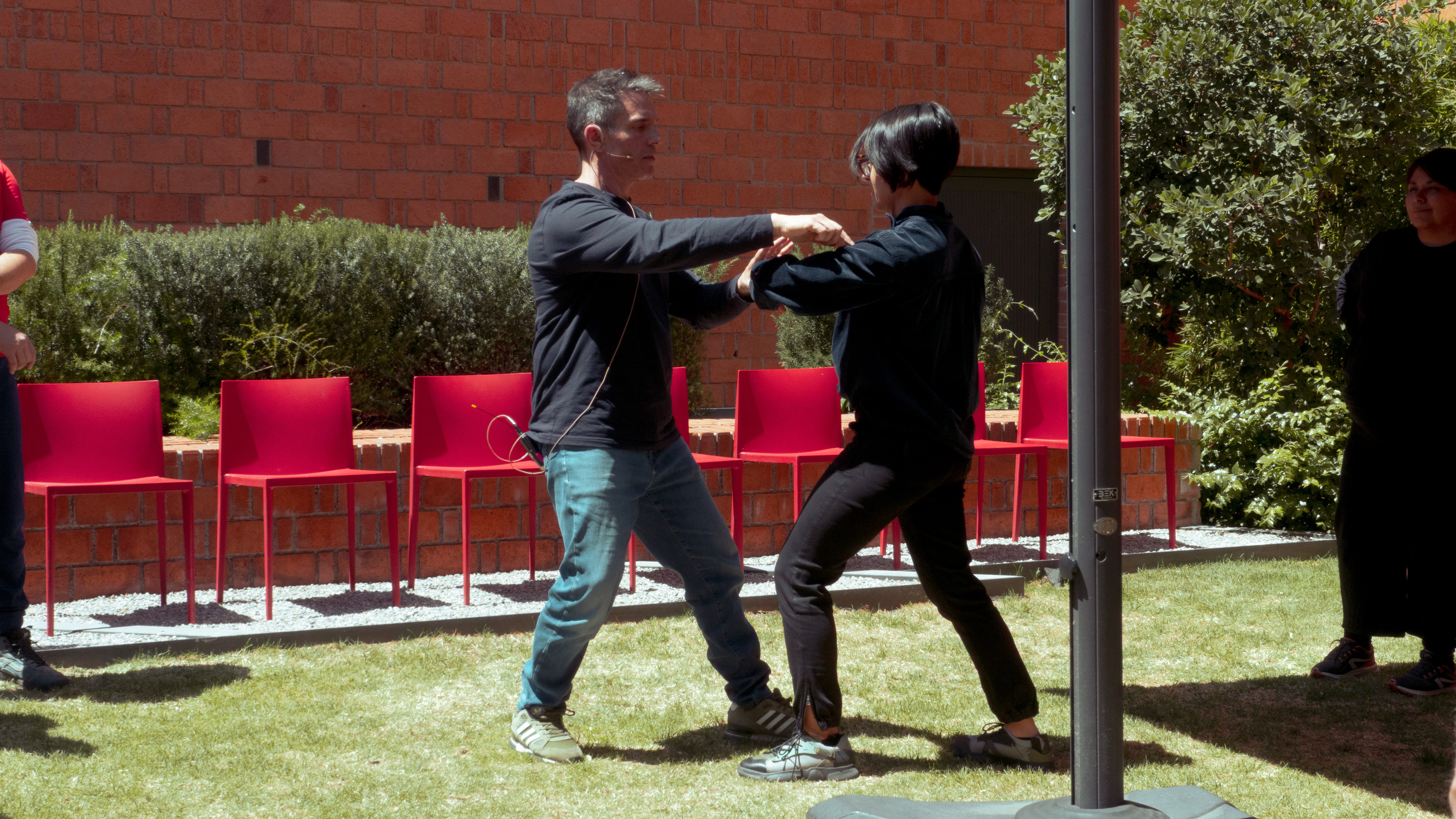
“Tension in this shoulder.” Tai Chi and Embodied Philosophy workshop, Universidad Iberoamericana, Mexico, 26 March 2026. Photos courtesy of Kamila Téllez Islas: Instagram @kammtei
In effect, someone well trained in taiji push-hands will register a push or pull on their hand or arm all the way through their own body, and that sense is immediately translated into logical movement and transfer of force counter options. Crucially, however, not only does one’s sense of touch does not end at the point of contact, of the interface of skin on skin. It expands also into an awareness of the other person’s body.
If I am doing taiji push-hands with someone less trained than I am, I will almost instantly feel – in my push on their forearm, the tenseness of their shoulder, the position of their body in relation to mine, where their weight is being held. I will know whether their shoulder is too high, whether their hips are pointing directly towards me or away from me, whether their legs are straight or bent, whether their weight is on front leg, rear leg, or both. And this instantly gives me options. If I can feel their tense and raised shoulder, I can push gently up into it, even for the briefest moment, and ruin their posture even more – forcing them to lean back, forcing their centre of weight to move outside the frames provided by their feet, making them easy to push away or over or to trip or throw, or to redirect, so that they fall to one side or the other, and so on.
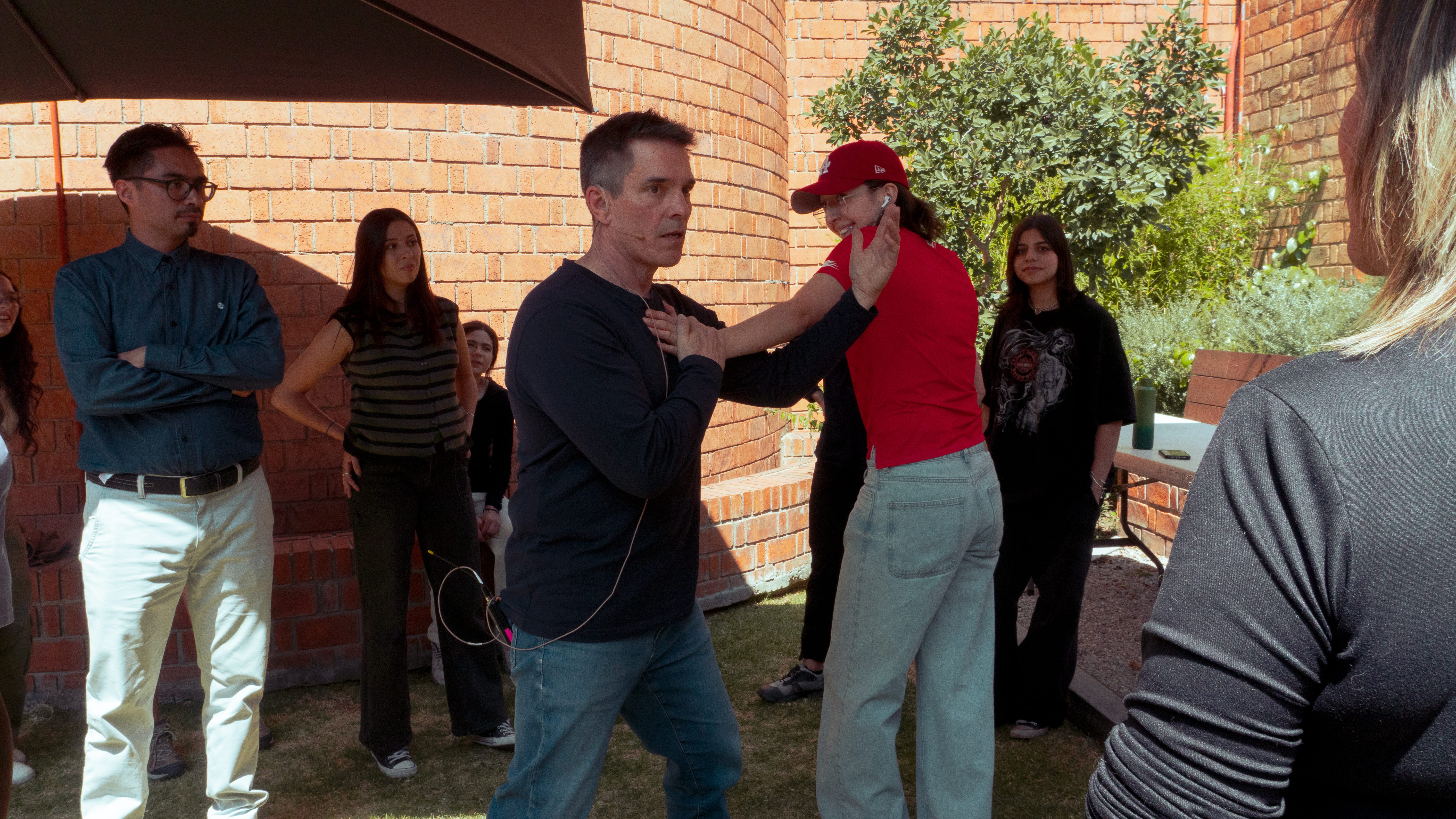
“Change the angle.” Tai Chi and Embodied Philosophy workshop, Universidad Iberoamericana, Mexico, 26 March 2026. Photos courtesy of Kamila Téllez Islas: Instagram @kammtei
If I feel that their centreline is pointing away from mine – basically, if I can feel that their navel is not pointing directly towards mine – then this means that I am pointing directly towards them while they are pointing away from me. It means I am on one side or the other of them, and this means I have a world of leverage options, as I can deploy forces to their sides, to their back, and so on. At this stage, however, push-hands training should normally have moved beyond the basic push-yield-push level of training, and into a stage in which other kinds of contact and touch are allowed – such as gentle manipulations of the wrist joint, the elbow, movement up to the shoulder or around the opponent’s neck, and so on; along with stepping and footwork, so that one could, for example, position one’s own leg behind the opponent’s leg, loop one’s arm around their arm or neck, and turn, so that they fall. At this point, taiji push-hands has more and more of the hallmarks of a specific kind of martial art or combat training.
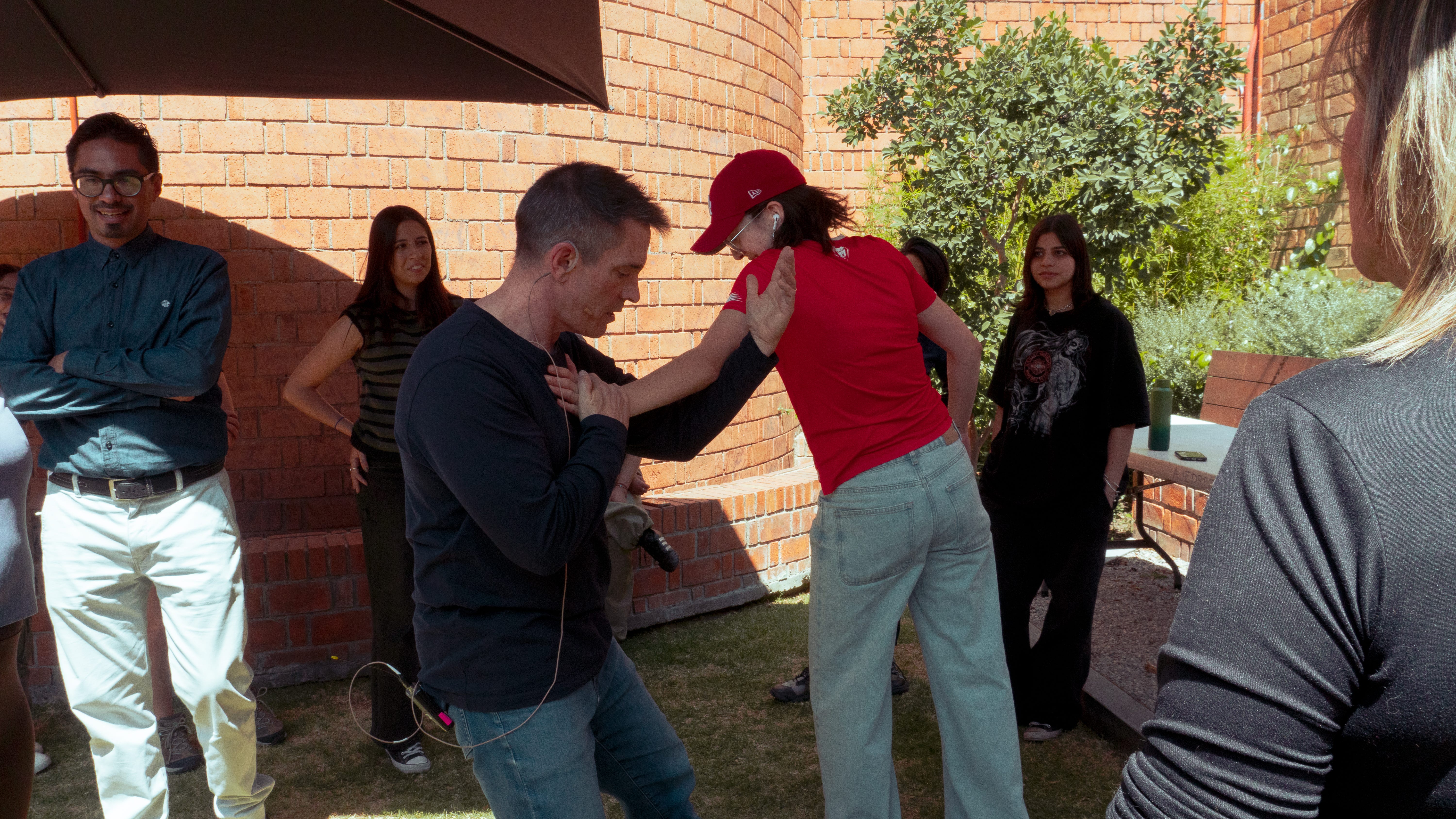
“Leverage and turn.” Tai Chi and Embodied Philosophy workshop, Universidad Iberoamericana, Mexico, 26 March 2026. Photos courtesy of Kamila Téllez Islas: Instagram @kammtei
However, even at this stage, what must never be lost is the status of touch in taiji. Once one arrives at this more free-flowing and combat-appearing level of push-hands, it is possible to see many of the same ‘techniques’ being used in taiji as in other arts. But these are entered and applied very differently. One does not decide to do a certain wristlock and then force one’s way into it, against a resisting opponent. One applies a wristlock if and when it ‘appears’ as an option. That is to say, one does not decide in one breath to apply a technique the next. One feels the presence of the possibility and actualises it at exactly the right moment. A moment too soon or too late would require excess force. The exact right time is when things happen as if effortlessly. The possibility of being able to do this depends entirely on one one’s sensitivity training in relation to touch.
Touch as ‘unsusceptible to being amplified’
In his seminal ethnographic study of learning taiji in Shanghai, Taijiquan and the Search for the Little Old Chinese Man: Understanding Identity Through Martial Arts, Adam Frank argues that the training of touch and the effects of the interactive touch-based practice of push-hands constitutes at once the most direct kind of contact with and the deconstruction of the separation between not only distinct cultures (East and West, say) but also senses of personal identity. In practising push-hands at length and in ever unfolding and concatenating ways, one’s own bodily identity or integrity becomes profoundly interconnected with that of the partner.
These observations may be important in any number of ways, and useful for any number of intellectual, ethical or aesthetic projects. Here, I merely want to entangle them with some arguments made by Eve Kosofsky Sedgwick in Touching Feeling. On the matter of touch, Sedgwick writes:
Even more immediately than other perceptual systems, it seems, the sense of touch makes nonsense out of any dualistic understanding of agency and passivity; to touch is always already to reach out, to fondle, to heft, to tap, or to enfold, and always also to understand other people or natural forces as having effectually done so before oneself, if only in the making of the textured object. (14)
She also argues that ‘The sense of physical touch itself, at least so far, has been remarkably unsusceptible to being amplified by technology’ (15). This is an interesting argument to make, and in one sense it is absolutely justifiable. When I recently reread this argument, however, I was slightly troubled by the question of whether the ‘sense of physical touch’ really was ‘remarkably unsusceptible to being amplified by technology’. What do we mean by touch? What kind? And what do we mean by technology?
In light of my experience of push hands, I suspected that things might not be quite so straightforward. Indeed, Sedgwick immediately continues by noting that there are of course some minor ways in which the sense of touch can be ‘amplified’. Allow me to quote more of this passage – including (again) the opening sentence:
The sense of physical touch itself, at least so far, has been remarkably unsusceptible to being amplified by technology. Women who do breast self-examination are occasionally taught to use a film of liquid soap, a square of satiny cloth, or even a pad of thin plastic filled with a layer of water to make the contours of the breast more salient to their fingers. But this minimal sensory enhancement is merely additive compared to the literally exponential enhancements of visual stimulus since Leeuwenhoek and Newton. The narrator of Middlemarch, one of the definitive novels of texture, can zoom in a mere two sentences from telescope to microscope [Eliot 83]. Once such visual ranges become commonplace the authority of the fingers will never be the same – though their very resistance to amplification may mean that they represent one kind of perceptual gold standard. (15)
Let’s unpack this. The sense and scale of sight can be manipulated massively by technology. It is entirely possible to move from microscope to telescope in the blink of an eye. Similar can be done with hearing, via technological means. However, Sedgwick argues, touch is just touch: one’s skin makes contact with something else, and that is touch, and that is all. There are no ‘touch microscopes’ or ‘touch telescopes’. You are either touching/feeling or you are not. However certain material (and chemical or psychoactive) additives can either enhance (e.g., ‘a film of liquid soap’) or retard (e.g., thick gloves) this sense of touching and feeling. But there is not much amplification to touch, at least, not of the order of telescopes or stethoscopes.
However, I would propose that there are other ways in which touch and feeling can be amplified by other ‘technological’ means. This may not involve either the sense of ‘amplification’ or of ‘technology’ intended by Sedgwick. However, my aim is not to win an argument against Sedgwick. It is rather to explore a region that is actually close to the heart of her areas of interest, but which she has not herself explored, simply because she was exploring something else.
The expansion and intensification of perceptual and technical touch-based skill is certainly not an amplification in the same way that microscopes and telescopes intensify and expand the sense of vision – i.e., for everyone with access to the technology. However, it is an expansion and amplification for the person trained within that practice, and although it involves no obvious or literal kind of technology, taiji push-hands uses one’s own body as an instrument, and another’s as both mover and moved object.
Thanks, Paul! This reflection is amazing and will remain stimulating and useful for a while, for different purposes. I haven’t studied Sedgwick in depth or read her closely. From what you point out, she appears to understand (and privilege?) touch as a perceptual system distinct from sight and other senses or systems, and distinct from technology (or certain technologies?) as well. Is that right? Could it be that she didn’t develop her understanding of technology in terms of a more sophisticated aesthetic/media theory (because she was doing something else)? I’m not planning to argue with/against Sedgwick, but that kind of problem is relevant to me. I tend to think that if touch undoes dualisms, oppositions, etc., that is because it happens everywhere, all the time. In sight, sound, language, technologies, etc. Even in absence. What you say about Tai Chi as a touch amplifier seems consistent with this.
Something I find particularly interesting about contemporary culture is that we are saturated by the pursuit and aggressive promotion of “experiences” across multiple cultural industries. Consider, for example, virtual reality games. Here, the aim of experience is to make us genuinely feel, even without “touching” — as Sedgwick would put it — thereby bypassing much of our embodied experience.
What seems problematic to me, however, is that within popular culture we are not taught how to touch “properly” or at the “right” moment. In other words, there is little to no pedagogy of tactile sensitivity. In that sense, we are like Robinson Crusoe: alone on our own island. More problematic still, given our tactile “illiteracy,” we increasingly delegate to technique and technology the task of providing us with these experiences without requiring any bodily effort on our part.
I wonder what our society would be like if this capacity were developed in a more integral way. What would our intuitions about the world look like? Would we not gain a far richer and more appropriate sensitivity, one that would enable us to establish a more intimate epistemic and aesthetic relationship with the world?
Thank you in advance for your reflections. They make me think, once again, about the importance of affects and bodily sensations as dimensions that the West is only beginning to recognize as fundamental axes of both human and more-than-human life.